
By R. Todd Swinderman, president emeritus, Martin Engineering
In a follow-on article to our safety feature in the May issue of African Mining, incorporating Mining Mirror, R. Todd Swinderman, president emeritus, Martin Engineering, tackles how to train employees to safely control fugitive materials in bulk material handling and implement these changes – to get a return on your conveyor investment. He notes that unfortunately, “half measures don’t get half results, so training alone won’t be sufficient. Following through on what has been learnt is the key”.
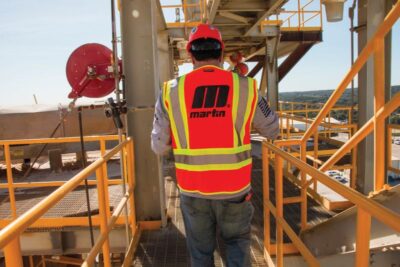
A professional safety inspection takes a third-party perspective of aspects that employees often overlook. ©2025 Martin Engineering
Where to start
A walkdown of one or two “problem belts” and a review of goals the day before the training helps the instructor focus on site- specific problems and management’s expectations. The survey and interview usually take a few hours to half a day. The goal is for the instructor to have actual examples to show employees that their problems are not necessarily unique. An experienced instructor will most likely have examples showing similar problems together with their solutions.
The first day typically starts with reviewing the typical problems and getting employees to share their specific challenges. After identifying a couple of problem conveyors the employees split into small teams. Each team can look at the same problem or select different challenges. Photos and videos of the issues are taken to be used in problem-solving discussions.
The balance of day one and the start of day two review basic design principles that relate to the problem conveyors. The discussion centres on possible root causes and solutions. Once the teams reach an agreement on a way forward, they prepare a short presentation with the help of the instructor, using their actual conveyor problems and the knowledge they have gained. The presentations may also include an estimate of the cost of the proposed solutions.
Management’s role
At the end of day two, management is invited to listen to the team presentations and solutions. By participating in the class presentations, management shows a commitment to making improvements and has an opportunity to ask questions. Creating and delivering the presentations, enables trainees to show the knowledge they have gained and support for the proposed solutions. The photos, videos and inspection sheets help shed light on issues and solutions crews experience every day. It is critical at this step that the manager(s) who attend the presentations have the authority to act on the proposals and are willing to commit to a pilot programme to prove the theoretical results can be turned into reality.
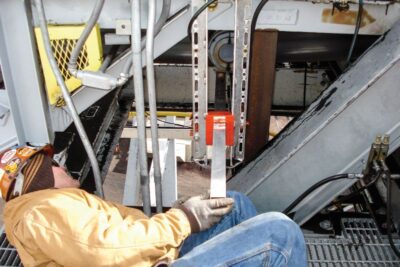
The Martin Conveyor Belt Carryback Gauge is a patented tool for estimating carryback on the return side of a conveyor belt. ©2025 Martin Engineering
Pilot programme
One or more conveyors are selected for a trial programme. While it is normal to select the “worst” conveyor, keep in mind that “half measures do not get half results”, so consider the project’s scope. Once a conveyor has been selected, detailed proposals for retrofit can be obtained. An experienced person from the selected equipment supplier should overview the designs, offer feedback and supervise the installation. Either outside contractors or in-house personnel can be used. Sufficient downtime must be allocated to properly modify the conveyor.
Measuring results from improvements is important and relatively easy to do. Photos and videos of before and after must be taken. Dust levels are measured using common instrumentation, spillage can be measured by placing buckets or trays in appropriate locations and carryback is measured by placing a tarp under several return idlers close to the discharge pulley. The collected fugitive materials are weighed for comparison after the conveyor has been modified. Dust and spillage sampling locations should be marked so the tests can be accurately repeated after retrofitting and an improvement percentage can be calculated.
The length of time for collecting samples can vary from a day to a week and should give a good representation of the average or typical operating environment and weather conditions. It is important to keep the dust monitor running even if the conveyor is running empty, as maximum fugitive dust levels are often detected when running conveyors empty long enough that the carryback dries out and becomes airborne.
Usually, the results of the pilot programme are immediately noticeable, but there is a temptation to assume the problem has been solved and to revert back to delaying maintenance without follow-up maintenance, causing the results to deteriorate. Therefore, the test period should extend to the next scheduled maintenance shutdown with periodic inspections and adjustments made by the equipment supplier in the interim to ensure optimum efficiency.
The payback on training
To demonstrate the benefit of safety to a company’s bottom line, the US Occupational Safety and Health Administration (OSHA) created the online tool, ‘$afety Pays,’ which uses company- specific economic information to assess the potential economic impact of occupational injuries on that firm’s profitability. The programme estimates direct costs (claim cost estimates provided by the National Council on Compensation Insurance) and indirect costs (provided by the Stanford University Department of Civil Engineering) and weighs them against financial details supplied by the company.
Conclusion
Experience has shown that the motivation to take action developed in training often defaults back to prior habits. Sometimes it is a lack of funding, an understaffed maintenance department or a “run-till-broke” mentality. The pressure to get back into production overwhelms the training that emphasises the understanding of the root causes of inefficiency and injuries such as fugitive materials. A production-at-all-costs approach means the problems and safety concerns never go away, and employees just have to accept the poor performance and added risks, which demoralise them.
It is incumbent upon management to take the safety and maintenance training as seriously as the staff, listen to the concerns of employees and fix the problem correctly the first time. As research has shown, companies that prioritise safety, training and updating equipment enjoy fewer safety incidents, less regulatory oversight, higher productivity and greater long-term profits.
Source: The Swinderman Scale of Fugitive Materials, Martin Engineering, R. Todd Swinderman. Aug, 2004. https://foundations.martin-eng.com/learning-center/learning-center/measuring- fugitive-materials-from-belt-conveyors-part-2