
By John Mubambe, contributing correspondent, African Mining, incorporating Mining Mirror
Kansanshi Mining is not just fueling its operations by integrating renewable energy solutions with vocational training, it is powering a pipeline of local talent that will support Zambia’s mining future long after the last ore is extracted.

A Kansanshi official, Webby Makoloni, training superintendent, explains the functionality of the 120-kilowatt solar power system to the permanent secretary and the district commissioner, during the commissioning ceremony in Solwezi. All images © John Mubambe
In a strategic move aligning renewable energy adoption with skills development, Kansanshi Mining Plc has commissioned a 120-kilowatt solar power system at Kwambula Trades Training Institute in Solwezi, Zambia. The K1.7-million (approx. USD75 000) project underscores a growing shift in Africa’s mining sector – where ESG commitments are no longer peripheral but are being integrated into core operational and community engagement strategies.
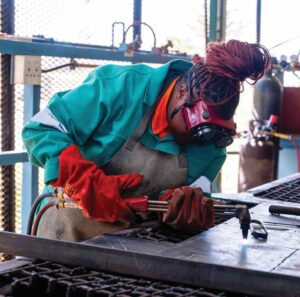
A female student participates in welding training, an outcome of Kansanshi’s inclusive skills development agenda.
The installation replaces the institute’s reliance on diesel-powered generators, ensuring uninterrupted electricity supply to classrooms, workshops, dormitories and administrative offices. It also responds directly to Zambia’s broader energy deficit, providing localised power resilience and continuity in training delivery.
“This investment ensures that practical, hands-on training in technical trades continues uninterrupted,” said Charlie Watt, Kansanshi’s training manager, who spoke on behalf of general manager, Meiring Burger. “It’s not just about infrastructure – it’s about enabling long-term development in our host communities.”
The solar rollout forms part of Kansanshi Mining’s broader educational investment strategy under First Quantum Minerals (FQM), its parent company and Zambia’s largest copper and gold producer. The company is injecting over K12-million (USD500 000) into Kwambula’s training infrastructure – including a K4.5-million rigging workshop, K3-million in new classroom space and administration building, a K1.2-million auto-electrical programme, and curriculum upgrades designed to align with evolving industry demands.
Northwestern Province Permanent Secretary Col. (Rtd) Grandson Wishikoti Katambi praised the initiative as a national example of mine-led development partnerships that deliver tangible community outcomes.
“What we are witnessing here is more than a power system – it is responsible mining in action,” Katambi said. “As government creates an enabling environment, Kansanshi and First Quantum are showing how private capital can generate shared value.”
He further highlighted the project’s long-term value. “When the mines eventually wind down, we want institutions like Kwambula to be part of their legacy – places that trained the artisans, engineers, and entrepreneurs who built this region.”
Kwambula Trades Training Institute was founded in 2012 to meet the growing demand for skilled tradespeople in Zambia’s mining region. Until the recent upgrade, the school’s dependency on a shared generator severely limited its operational capacity. Kansanshi’s solar investment has now transformed the facility into a self-sustaining technical training centre with the capacity to train over 110 students annually.
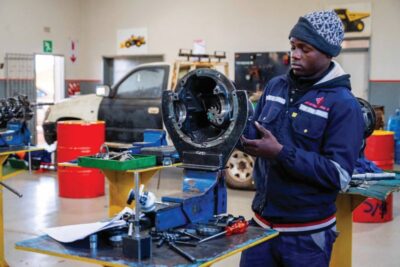
Skills for the Energy Transition: Graduates from Kwambula are being equipped
with practical expertise vital to the future of Zambia’s mining sector.
Disciplines offered include heavy equipment repair, metal fabrication, instrumentation, auto-electrical maintenance, and mechanical fitting, rigging and power electrical trades that are vital to the mining and construction industries.
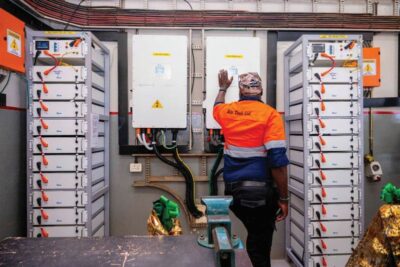
Solar power project’s facility at Kwambula Trades Training Institute.
Solwezi district commissioner Tedson Mulofwa commended Kansanshi’s gender-inclusive approach, noting a rising number of female trainees entering previously male-dominated trades.
“This project is not just lighting classrooms – it’s illuminating opportunities for all, regardless of gender,” he said.
The Kwambula initiative demonstrates how sustainability targets can align with local socio-economic development. Beyond its technical function, the solar installation is a talent development enabler – powering skills that are essential to the future of mining.
“This is more than a power system – it’s a platform for your growth,” training superintendent, Webby Makoloni told students during the commissioning. “You are not just learners; you are future technicians, managers, and entrepreneurs. Embrace that role.”
Kansanshi is already considering replicating this model across other community institutions in the region. The company also continues to import power from the SADC region, reinforcing its strategy to reduce reliance on Zambia’s strained national grid.
As global markets increasingly demand responsibly sourced minerals, especially copper and gold critical to the energy transition, Kansanshi’s approach offers a replicable model of how mining companies can embed community upliftment into their sustainability playbook.
Note from the editor: Our deepest sympathies go out to John Mubambe’s family, friends and colleagues on his passing in August 2025. John was a valued contributor to African Mining, incorporating Mining Mirror. As a freelance journalist and executive writer from Solwezi – Zambia, John was known for his work covering the African gemstone and jewellery industry and the impact of solar energy on rural areas, and far more. We celebrate John for his contributions to journalism.
| Introducing the author:
John Mubambe is a freelance journalist based in Solwezi, Zambia, a vital hub of the country’s mining activity. His work focuses on mining, business and community development, with a particular interest in how the extractive sector shapes local economies and livelihoods. With several years of experience writing for both local and international publications, Mubambe brings an on-the- ground perspective from Zambia’s mining frontier. His reporting explores the evolving relationship between mining operations and host communities, covering key themes such as corporate social responsibility, infrastructure development and sustainability. He has contributed to African Mining, incorporating Mining Mirror, and other platforms that delve into Africa’s mineral wealth and the socio-economic dynamics surrounding it. Mubambe is committed to telling stories that connect industry leaders, policymakers and the communities affected by mining, aiming to foster greater understanding and accountability across the sector. Through his work, he offers readers fresh, informed insights from one of Africa’s most dynamic and rapidly evolving mining regions. |