
By Dr Paseka Leeuw, School of Mining Engineering head, professor Bekir Genc and Ohveshlan Pillay, University of the Witwatersrand School of Mining Engineering
Scientific progress in the mining sector needs to be underpinned by a steady flow of young graduates, who are grounded not only in their established disciplines but who can see the opportunities afforded by new technologies.

Students in the mock mine at Sibanye-Stillwater Digital Mining Laboratory (DigiMine). All images supplied by Witwatersrand School of Mining Engineering
To achieve this, the learning process must be infused with constant collaboration between the university and mining companies. As a key consumer of technology, mining practitioners are always absorbing innovations into their disciplines, which raises the bar for their professional performance and that of their mining operations. The more we practically expose our students to the industry during their studies, the more they can understand and advance the technologies they learn about.

Dr Paseka Leeuw, School of Mining Engineering head, University of the Witwatersrand School of Mining Engineering.
Digital progress
The runaway pace of digital innovation, for instance, highlights the value of data in tracking and optimising mining and process plant operations. Within the Wits School of Mining Engineering’s teaching and research, we focus increasingly on the conversion of data into information, and in turn into knowledge and business intelligence.
This is done most effectively through strong relationships with mining industry players, which is why the school works hard at opening doors for students. We consider it crucial to facilitate, as far as possible, the passage of students into the sector – into mining companies and other organisations who share our commitment to skills development. This is a two-way street, as students need experience, and companies can be rewarded by the value of the research and other contributions that our students offer over time.
A vital platform provided to students by the school includes not only foundational knowledge in science and engineering, but the inspiration and ability to think in innovative ways about problems and their solutions. Industry expects a high level of problem- solving ability, and the school must also meet the stringent requirements of the Engineering Council of South Africa – which accredits our courses.
Joining hands
Students in the school’s post-graduate programme contribute directly to innovation in mining through their research reports. More than half of our postgraduate research is aimed at solving a specific challenge faced by the sector. We collaborate with research institutions like the Mandela Mining Precinct and the Council for Scientific and Industrial Research (CSIR).
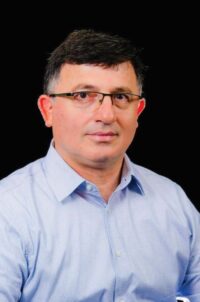
Professor Bekir Genc, responsible fornresearch and innovation at Wits Mining School.
The school draws extensively on industry skills when conducting academic assessments; we engage leading professionals in the mining sector for roles such as external examiners, for instance. As academics, we also co-teach and co-assess with these experts in the field, who often contribute to our lecture programmes. On the other side of the coin, we encourage students to engage with industry professionals – which they can effectively do through the mining sector’s various associations and societies.
It is also important for the university to open its doors to industry, as part of our mutually supportive partnership. The South African National Institute of Rock Engineering (SANIRE), for example – which holds regular gatherings each year – comes to Wits for one of these meetings. Students make valuable connections at these events and learn directly from the technical talks. Similarly, other organisations across the mining sector host technical events and forums to which our students are regularly exposed to.
Research impacts
As importantly, our teaching staff will often guide postgraduate students into research projects with direct value for mining companies and supervise these projects to ensure the most productive outcomes. This adds considerable value to the whole sector, often in immediate financial terms but especially in longer term innovations.
Another aspect of the partnership between academia and industry is the impact of our research. The research of postgraduate students is frequently published in respected journals alongside their academic supervisors, who are themselves often leading lights in one of the mining disciplines. A leading rock engineering expert and emeritus professor at the school, Professor T.R. (Dick) Stacey, acknowledged the role of student research in a 2017 paper he wrote on‘Rock Engineering as a Creator of Value’.

Ohveshlan Pillay, lecturer at Wits Mining School with a focus on rock engineering, and chair of the South African National
Institute of Rock Engineering (SANIRE), Gauteng Branch.
He called the paper a ‘celebration’ of the students he had supervised in his field over the years. Conducting their research while employed on mines, in consulting companies and in research organisations, these students make a valuable contribution to the mining industry.
Without the willingness of industry players to reach out to undergraduates and postgraduates alike, we would not enjoy the fruits of collaboration to the extent that we do. There is much more we can do together, however, and the School of Mining Engineering at Wits will continue to build these bridges in the interests of scientific advancement.