
Compiled by Sharon Mdaka, edited by Sharyn Macnamara
Much commitment, research, collaboration and brass-tacks hard work have been invested in moving towards a goal of zero harm in mining operations, with particular focus on preventing fall of ground (FoG) incidents. As the saying goes, “one fatality is one too many”.
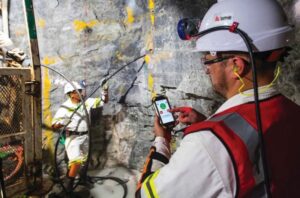
Leveraging Xplolog for smarter underground blasting operations. Supplied by BME
It is no secret that mining carries risks, but what’s also true is that the industry is dedicated and deeply invested in initiatives to find practical solutions to the challenges that lead to fatalities to ensure safe mining.
With the introduction of advanced support systems for blasting and AI-driven analytics, there’s been a greater push for technological advancement in pursuit of safer operations. However, the question remains: Is the mining industry any closer to reaching its target of zero harm and how can innovation and technology help save lives while improving efficiency and sustainability?
FoG remains one of the most critical safety risks in South Africa’s underground mining sector, warns Lerato Tsele, deputy head for Safety and Sustainable Development at the Minerals Council South Africa. Gravity-induced failures, such as loose rock or inadequate support, continue to account for the majority of incidents. In 2025 alone, gravity-related FoG incidents claimed eight lives.
The highest-risk activities occur at the stope face, particularly during entry examinations and support installation, where workers are exposed to unstable ground conditions. Seismic events and rock bursts have further compounded these risks, tragically resulting in multiple fatalities.
Tsele emphasises that mines must adopt a proactive and integrated approach to FoG risk management, which includes:
- Adopting leading practices currently being promoted under the Falls of Ground Elimination of Fatalities Action Plan (FOGAP), such as improved underground illumination, permanent aerial support, strengthened entry examination protocols and strict compliance with support standards.
- Investing in training and capacity building, particularly for rock engineers, as the industry faces critical shortages due to emigration and retirement.
- Participating in industry-wide initiatives like the FOGAP, a comprehensive programme addressing FoG prevention through research, technology and best practices, and Khumbul’ekhaya 2.0, which focuses on leadership accountability and cultural transformation to improve safety performance.
Several promising technologies and trends are currently in research and pilot phases as part of FOGAP implementation. Photogrammetry for hazard detection, for example, is being developed as an early warning system for ground instability. Prototypes have shown positive results and are moving toward commercialisation. “Research is ongoing to develop improved seismic management tools and interventions that significantly enhance the prediction and control of seismic events,” says Tsele, adding that capacity building for rock engineers remains crucial to retain critical skills for ground control.
The new-generation hydropower drill is another innovation with significant advantages. Weighing half as much as traditional pneumatic drills, it offers faster, more accurate drilling. When mounted on a drill guide, it can be operated remotely, reducing operator exposure to hazardous conditions. Tsele notes that these innovations are currently being investigated for possible promotion as leading practices for FoG risk reduction.
Exoskeletons for barring activities are also currently being piloted to reduce fatigue and improve safety during one of the most hazardous underground tasks. “These technologies, combined with strong governance and industry collaboration, have the potential to transform FoG risk management and improve safety performance across the sector,” concludes Tsele.
Meanwhile, for companies like Duraset Strata Control, Mine Support Products (MSP) and BME, research, smarter engineering and the integration of digital intelligence underground is the way to go.
Duraset Strata Control
As a solutions-driven company, Duraset Strata Control has been supplying engineered support solutions to the mining and geotechnical sectors for decades. Their head of technical and production functionalities, Gerhard de Kock, spoke to African Mining, Incorporating Mining Mirror, about the company’s solutions for FoG incidents.
The company supplies products that absorb energy to prevent rock falls from occurring due to seismicity and impulses from rock movement.
“You restrain the rock, although you allow a little bit of movement. This is innovative and unique,” explains de Kock. “Currently, we have two products in the market with great success, the DT6 and DT8 – both are yielding products that absorb energy in the bolts to allow movement in the rock faces.”
The DT6 achieves a yield load between 90–130kN, absorbing 25– 35kJ of energy. The DT8 operates between 150–170kN, absorbing 45–55kJ over a typical 300mm yield. Each bolt is highly complex to manufacture, requiring precision assembly and stringent quality control. De Kock adds that it takes three to four years of research and development to bring a product like this to market.
Beyond technology, however, he highlights two ongoing challenges: skills shortages and a lack of underground discipline. “You can have the best product in the world,” he says, “but, if it’s not installed or used correctly, the risk remains.”
Mine Support Products (MSP)
MSP’s flagship product, Rocprop, has been serving the gold industry for decades.
“Rocprop was first developed to keep gold mines open,” says Peet Swart, business development manager at MSP. “It’s a steel elongate that caters for closure and seismicity. Historically, miners used timber poles in conventional mining, but as mines went deeper, the pressure and closure increased and tunnels began closing in on themselves.”
Rocprop addresses this challenge by absorbing static or dynamic closure, providing predictable and resilient support underground.
Another critical product, Rocmesh, offers permanent aerial support to protect miners from potential rock falls. According to Christian Nissen, MSP’s technical manager, Rocmesh has proven highly effective over the past two to three years in reducing FoG-related injuries.
Swart explains that Rocprop offers not only safety benefits but also major logistical advantages, “In platinum operations, for instance, you can load 120 Rocprops on a materials car instead of 20 timber poles, reducing logistics by six times. Installation takes just two minutes compared to fifteen for a timber pole. That’s a massive improvement in both safety and efficiency, and therefore it can also potentially increase production.” A few trials were done on various platinum mines and the concept has been proven with excellent results.
Staying ahead of the curve, MSP, in collaboration with Badger Mining, is also investing in a monitoring unit. Nissen explains, “We’ve developed a monitoring unit that acts like a load cell; it measures force and can be integrated into or mounted on the product. When installed correctly, it flashes green. If there’s movement or increased load, it flashes red or yellow, warning operators in real-time.”
This kind of smart monitoring bridges the gap between human error and technological reliability, giving miners a literal warning light underground.
BME: blasting intelligence
For BME, innovation starts before the rock is even touched. The company’s underground regional manager, Derrick Menezes, explains that FoG incidents are often rooted in geological instability, seismic activity and inadequate support systems, all of which can be influenced by how the rock is blasted.
“Contributing factors include poor rock mass quality or fractured ground conditions, the delayed or insufficient installation of support structures, seismic events triggered by blasting or mining- induced stress and human error and lack of adherence to safety protocols,” Menezes explains.
BME’s suite of advanced blasting technologies and electronic initiation systems plays a critical role in managing FoG risks. Precision blasting reduces overbreak and minimises vibration, helping preserve rock integrity.
“Our Axxis Titanium™ electronic detonators offer controlled timing and reduced seismic impact, which is essential in sensitive underground environments. The blast design software enables predictive modelling to optimise fragmentation while maintaining ground stability. While our Innovex™ emulsion offers controlled energy through its high- or low-density product variants and reduces overbreak and minimises vibration, helping preserve rock integrity,” he says.
BME has integrated real-time data analytics and monitoring tools into blasting solutions with the BlastMap™ platform, allowing for detailed analysis of blast performance and its impact on surrounding rock structures. The company’s recent collaboration with Strayos and the launch of XPLOSMART™ further position BME as a leader in blast solutions for mining, with AI insights and analytics.
“We collaborate with partners to incorporate geotechnical sensors and seismic monitoring into underground operations, enabling proactive ground control decisions. These innovations support the industry’s move toward smart mining and predictive safety management,” he adds.
According to BME field trials and client feedback have shown:
- Up to 30% reduction in seismic-triggered FoG incidents when using precision electronic initiation systems.
- Improved compliance with support installation timelines due to better blast predictability and reduced re-entry delays.
- Enhanced rock mass stability in high-risk zones through optimised blast sequencing and reduced energy transfer.
Menezes believes the following trends are impacting successes in ground control and FoG prevention:
- AI-driven predictive modelling for seismic risk and ground movement
- Automated support installation systems and remote drilling technologies
- Permanent areal mesh installations and smart support units
- Integration of IoT sensors for continuous underground monitoring
Innovation and technological advancements are reshaping how the industry approaches ground control, with a strong focus on the goal of zero harm and proactive safety strategies.