
By Sharon Mdaka
BME’s Losberg manufacturing plant, situated approximately 75km south-west of Johannesburg, is its Centre of Excellence for production, engineering and product innovation. African Mining, Incorporating Mining Mirror writer, Sharon Mdaka, recently visited the plant.
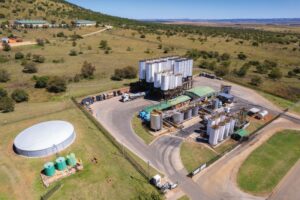
The BME’s Losberg manufacturing plant, situated approximately 75km south-west of Johannesburg. All images supplied by BME
As part of the Omnia Group, BME has positioned its Losberg plant at the core of its global manufacturing network, supplying the mining industry with a full range of emulsion explosives, initiation systems and blasting accessories that ensure safe and efficient rock breaking across Africa and beyond.
At the heart of BME’s operations lies a sophisticated supply chain designed for security of supply and production resilience. The site is also well positioned to serve the concentration of mines in the area. “The Losberg site provides essential governance, engineering and process optimisation for all our international operations,” explains Dirk Voogt, general manager for Production and Logistics at BME. “Through our integrated Sales and Operational Planning (S&OP) process, we ensure continuity and flexibility across our South African and global facilities.”
The facility’s capabilities include the production of pumpable emulsions, ammonium nitrate-based products and detonator assemblies, including electronic initiation products and shock tube systems. Omnia’s dual redundancy in nitric acid and ammonium nitrate production at the Sasolburg Nitrates complex, combined with three sources of ammonia (one imported), provide exceptional supply stability for BME’s manufacturing lines.
According to Voogt, the Losberg sites’ systems are fully digitalised, allowing real-time process control, data acquisition and product traceability across multiple production lines. “Sustainability is a fundamental principle of any manufacturing capability and BME is committed to operating with minimal environmental impact while promoting local employment, business development and skills growth. Our modern manufacturing plants incorporate the latest in digitised process control and optimisation technologies, all while maintaining a minimal environmental footprint.”
From harnessing solar energy and implementing continuous in-line manufacturing techniques to adopting robotics in assembly and process control, BME’s manufacturing processes are streamlined to deliver consistent product specifications and output with minimal energy input.
“On the product front, our pumpable emulsions and emulsion technologies have undergone continuous development. We now use a class-leading proportion of reprocessed waste oil in our formulations, consuming over 27 million litres of recovered and processed waste oil annually. This not only removes a significant environmental pollution risk but also reduces reliance on newly sourced carbon by as much as 90%. As a result, we significantly lower the carbon footprint of our products during application (Schedule 1 emissions) and reduce Schedule 2 and 3 emissions that would be associated with sourcing newly mined or extracted carbon sources such as diesel and other crude oil-based fuels,” adds Voogt.
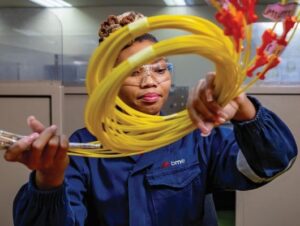
Losberg sites’ systems are fully digitalised.
For Monica Matomane, Production manager for Initiation Systems, automation has transformed both safety and quality. “Automation allows us to capture every process parameter and image in real time. If a component fails, we can trace its full production history. In manual systems, you rely on memory or paper records, now, you rely on evidence,” she explains.
Her team’s work focuses on shock tube assemblies and electronic detonators (EIS), using automated machinery equipped with PLC- controlled robotic systems. “Our combined coiling and assembly machines allow rapid configuration for different tube lengths, making production responsive to customer demand,” she adds.
Safety remains non-negotiable. All changes to process or equipment follow a strict Management of Change (MoC) procedure, while technical staff undergo continuous in-house training accredited through BME’s Learning Management System (LMS).
“It starts with recruitment, getting more technical people and ensuring that the environment is also more open for innovative people. We recruit from mechatronics, automation and electronics backgrounds,” says Matomane. “We’re assembling components as small as 5mm, so precision and attention to detail are critical.”
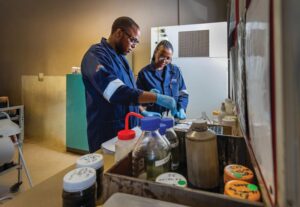
The facility’s capabilities include the production of pumpable emulsions and ammonium nitratebased products, among others.
For the future, BME’s research and development teams are expanding the Losberg site’s role into digital innovation and greener explosives. “On the digitisation front, artificial intelligence (AI) and its integration into mining optimisation tools are leading the way in modern mining innovation. BME has partnered with specialist provider Strayos to embed AI functionality into its suite of blasting support and design software through the launch of XPLOSMART. This integration will empower our customers to optimise the entire mine-to-mineral extraction process by aligning blast outcomes with optimal recovery rates and minimal input costs,” says Voogt.
From a physical product technology perspective, BME continues to increase the recycled oil content in its emulsion formulations. This not only contributes meaningfully to its ESG goals but also creates opportunities for local and host community SMEs to participate in the collection and supply of used and recycled waste oils for BME.
From a continental perspective, the Losberg site’s innovation ripple is significant. BME’s modular plant strategy, accelerated by Covid-19 disruptions, now supports in-country production across Africa and globally, enabling local employment, skills transfer and reduced logistical dependency.
“Our approach ensures that African mines can access world-class blasting technology produced locally. Every system leaving the Losberg site contributes to safer, more efficient mining across the continent,” says Matomane.
BME’s operations in South Africa, supported by facilities in Zambia, Namibia, Mali and Burkina Faso, as well as in Canada, Indonesia and Australia, demonstrate the global reach of African-developed technology. “Our international success proves that South African engineering and manufacturing expertise can compete and lead on the world stage,” adds Voogt.
A division of JSE-listed Omnia Group, the company’s success is driven by a customer-centric approach and a strong commitment to service, underpinned by deeply embedded values.
“Through the internalisation, commercialisation and optimisation of numerous technologies – and ongoing product development – BME’s subject matter experts and operational teams have become masters of these technologies. This enables them to deliver and support the implementation of real-world solutions for both operational challenges and opportunities,” he concludes.