
By Sharon Mdaka
There has been an increase in falls of ground (FoGs) incidents between 2024 and 2025, with the number rising from 12 to 15.
Japie Fullard, chairperson of the Minerals Council CEO Zero Harm Forum. All images by © African Mining, incorporating Mining Mirror
This was outlined by the Minerals Council South Africa (MCSA) at Day Two of the Investing in African Mining Indaba 2026. Addressing developments in mining health and safety, the organisation also highlighted increases in noise-induced hearing loss (NIHL) and musculoskeletal disorders.
For 2025, the industry recorded 41 fatalities, a slight drop from the 42 fatalities recorded in the previous year. “While we note that this was the second successive year of the lowest number of fatalities in our sector, we acknowledge that 41 families have lost their loved ones, as have friends and colleagues. We extend our heartfelt condolences to them,” said Japie Fullard, chairperson of the Minerals Council CEO Zero Harm Forum.
Fullard emphasised the importance of intentional action and collaboration in achieving safety goals in the mining industry. He said CEOs play a crucial role in enabling their companies to execute action plans and prioritise worker safety and health.
“As mining CEOs, we believe that Zero Harm is possible. If you consider the significant reduction in fatalities, injuries and illnesses in the sector over the past three decades, you will understand why we hold this belief,” said Fullard. In the coal industry, there were eight months up to the end of August 2025 without a fatality.
During the media briefing, Dushen Naidoo, head of Safety and Sustainable Development, and Dr Thuthula Balfour, head of Health and Safety, said there has been a 12% reduction in serious injuries to 1 693 from 1 925 in the same period.
Fatalities over the past three decades have reduced by 91%, falling to 41 in 2025 from 484 in 1994. Serious injuries have declined by 80% to 1 693 from 8 347 over the same period. Sector focus on leading causes of fatalities, including falls of ground and transportation incidents, has contributed to this reduction.
Increased attention at CEO level and the sector’s adoption of leading practices have driven significant improvements in safety. However, there was a worrying 25% regression in fatalities related to falls of ground, which increased to 15 deaths in 2025 from 12 the year before.
The Minerals Council’s CEO-approved Fall-of-Ground Action Plan contributed to the record low of six FoG fatalities recorded in 2022. The number of FoG fatalities fell by 78% to an average of 24 a year in the 2016–2020 period, compared to an average of 111 a year between 2001 and 2005. Key interventions included entry examinations, daily workplace safety checks, and the introduction of netting and bolting of tunnel roofs and walls in 2012, now a standard feature in South Africa’s deep-level mines.
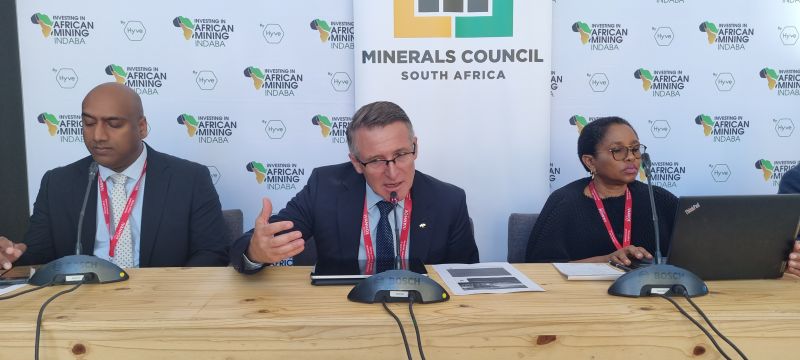
Dushen Naidoo, head of Safety and Sustainable Development, Japie Fullard, chairperson of the Minerals Council CEO Zero Harm Forum and Dr Thuthula Balfour, head of Health and Safety.
The Minerals Council said its most important partnership remains with the Mines Inspectorate in the Department of Mineral and Petroleum Resources and organised labour, as the industry works toward Zero Harm. Member CEOs meet on the first working day of each month to share lessons from safety incidents, analyse root causes and implement corrective actions.
“It’s only through sharing like this that we grow our knowledge base and not repeat the mistakes that have hurt or killed our colleagues. It is a very powerful platform, and I’m encouraged by the seriousness with which these sessions are treated,” said Fullard.
In the past 15 years, tuberculosis and silicosis cases have reduced by more than 80%. TB incidence has fallen to 220 cases per 100 000 employees, roughly half the national average. Cases of noise-induced hearing loss have declined by 55% over the same period, although it remains an area of focus.
According to Department of Mineral and Petroleum Resources data, total occupational diseases reported by mines decreased by 7.6% from 1 864 in 2023 to 1 723 in 2024. The mining sector employs approximately 470 000 people.
In 2026, the Minerals Council plans to strengthen efforts to sustain improvements in health and safety through deeper embedding of critical control management, broader adoption of leading practices, enhanced learning and knowledge sharing, stronger visible leadership, and continued industry collaboration through the Mine Health and Safety Council.