
By Sharon Mdaka
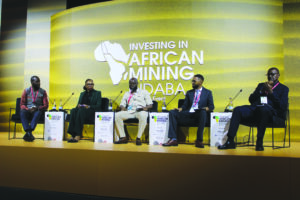
With artisanal and small-scale mining (ASM) said to produce about 20% of the world’s gold and critical minerals, a panel discussion moderated by Mkhululi Ncube, programme management officer at the African Minerals Development Centre (AMDC), unpacked Africa’s handling of the formalisation of ASM and whether it can truly unlock value addition.
© African Mining, incorporating Mining Mirror
The panel held at the 2026 Investing in African Mining Indaba brought together deputy director general for Mining, Mineral and Petroleum Policy Development, Ntokozi Nzimande, from South Africa’s Department of Minerals and Petroleum Resources; Mohammad Stevens of the African Legal Support Facility (ALSF); Norman Mukwakwami, global head of responsible sourcing – metals at Trafigura and Popol Mabolia Yenga, managing director of the Democratic Republic of Congo (DRC) mining registry.
South Africa is known for its rich history of formalised mining on the African continent, however, for years policy framework did not clearly regulate ASM. In 2021, the South African government developed an Artisanal and Small-Scale Mining Policy, which was approved by Cabinet in 2022. As it stands, the country is now reviewing the Mineral and Petroleum Resources Development Act (MPRDA) to introduce clearer provisions for both small-scale and artisanal mining permits.
“We are currently amending the MPRDA to include a small-scale mining and artisanal mining permit. The goal is to regularise activities, bring miners into the formal economy and ensure responsible environmental practices,” stated Nzimande.
Nzimande emphasised that illegal mining is a criminal matter, whereas artisanal mining, when structured and licenced, is an economic activity that can be formalised and supported. She said reform policies are meant to serve as a guideline for miners to operate legally, have access to financial support and comply with environmental requirements.
Responding to Ncube’s question on how the DRC is formalising ASM as a pathway to value addition, Yenga explained that artisanal mining in the country emerged out of economic necessity.
“At some point, the government put into place a decree recognising the situation and established artisanal zones,” he said. “But this is not enough, because there is a lack of organisation.”
“Before the collapse of state-owned mining companies in the DRC, they controlled mineral production. Due to mismanagement and bankruptcy, many workers were left unemployed. With mining knowledge but no jobs, they turned to artisanal mining for survival. Today, an estimated 2–3 million people are engaged in artisanal mining in the country,” explained Yenga.
Stating that the government responded by creating artisanal exploitation zones and establishing co-operatives to organise miners, as well as revising the 2018 Mining Code to provide stronger support for ASM.
In regions like Kasai, even when no industrial company was operating, diamond exports reached approximately USD300-million annually, almost entirely from artisanal production. The DRC’s experience highlights a broader continental truth: ASM is often born out of economic displacement. Formalisation, therefore, must address both regulatory clarity and social protection.
Speaking on behalf of the African Legal Support Facility, Stevens emphasised that not all African mining codes explicitly incorporate ASM. “I come from Sierra Leone, which has a long history in the mining sector. Our laws already cover licensing for artisanal, small-scale and large-scale mining. There are clear guidelines as to who can become an artisanal miner,” Stevens said.
“For example, the applicant must be a national, acreage is limited, permits periods are short and tools are categorised and clearly stated. We are currently supporting the development of an African ASM Continental Strategy to provide a blueprint for governments,” stated Stevens.
Representing the private sector, Mukwakwami argued that formalisation is often misunderstood. “In my view, governments cannot formalise ASM alone. This is not to say governments do not have the power to do it. But effective formalisation is not just about meeting regulatory requirements – it is about ensuring that products go into international markets at a standard that those markets will accept.”
For there to be formalisation, the following must be considered, which includes legality, professionalisation, access to financial services and market requirements. “If minerals from ASM are to enter global supply chains, whether gold, cobalt or copper, they must meet international environmental, social and governance (ESG) standards. Therefore, effective formalisation requires clear licensing pathways, regional co-ordination, co-operative structures, market clarity and stakeholder collaboration,” he explained.
Noting that formalisation is about livelihoods and dignity, not just regulation. The policy shift across Africa appears to be moving from tolerating informality to structuring it. Another question is whether ASM and large-scale mining can coexist. The panel believes the two can co-exist.
Whether through South Africa’s permit reforms, the DRC’s artisanal zones, or continental legal blueprints supported by ALSF, governments are acknowledging that ASM cannot simply be policed away.
The question now is whether formalisation will unlock access to capital, safety and downstream beneficiation or whether it will remain confined to regulatory paperwork. If formalisation is to become a pathway toward value addition, it must connect policy reform with market access and social inclusion.
© African Mining, incorporating Mining Mirror